
When a company begins to scale rapidly, managing access permissions becomes a major challenge for the IT department. Each new employee or department requires additional permissions.
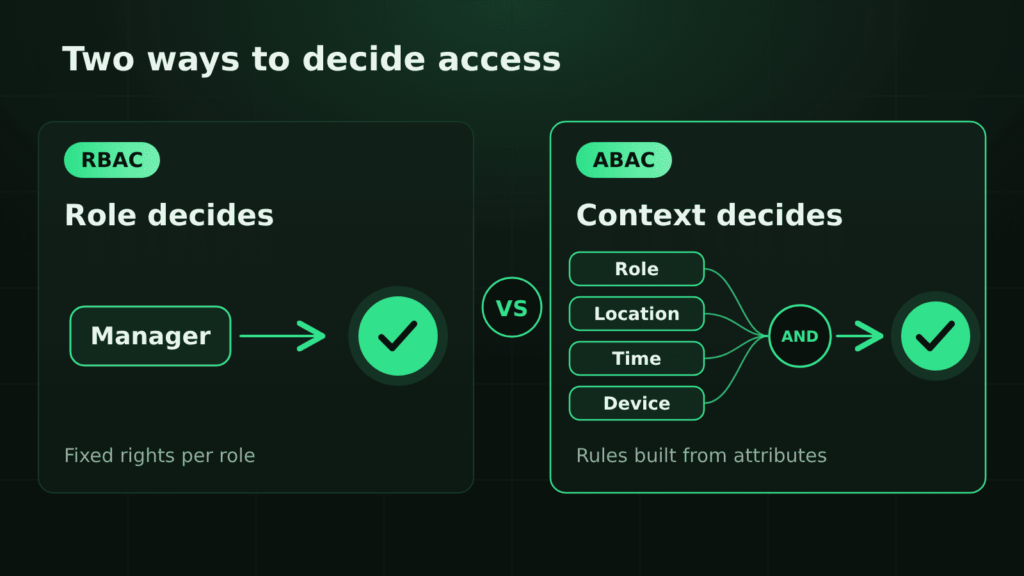
This brings network architects to a key decision: RBAC vs. ABAC. Both models help protect information, but their logic is radically different. The reliability of the entire corporate database and employees’ day-to-day productivity depend on choosing the right approach.
Core of Role-Based Access Control vs Attribute-Based Access Control
The difference between the two approaches lies in the decision-making mechanism itself. The first model assigns permissions based on predefined roles. If a person works as an accountant, he automatically receives all the rights of the accounting department. This is a classic access control that is great for companies with a static and very clear structure.
The second model takes a more flexible approach. It evaluates not only the job title, but many dynamic factors. The system checks the time of day, geolocation, device type and file security level.
| Characteristic | RBAC (Role-Based Model) | ABAC (Attribute-Based Model) |
| Basis for access | Job title or department | Dynamic conditions: time, geolocation, device |
| Configuration flexibility | Low; rules are fixed and static | Very high; rules adapt to the situation |
| Implementation complexity | Easy and quick to set up initially | Requires time to define condition logic |
| Behavior at scale | Quickly becomes chaotic due to role explosion | Maintains order well in large organizations |
| Practical example | An accountant is allowed to open financial reports | An accountant can open reports only from an office laptop between 9:00 and 18:00 |
Well-thought-out cloud access management allows you to combine these rules as flexibly as possible. Thanks to this, the authorization process becomes extremely accurate. Basic authentication only verifies a user’s identity during login, while these two models decide exactly which files a person will have access to after a successful check.
Where RBAC Shines and Where It Fails
The classic role model remains the most popular choice for a quick start. It is very easy to set up. The basic identity lifecycle becomes as transparent as possible. When someone takes on a new role, they immediately receive a predefined set of permissions. When the specialist leaves, the administrator removes absolutely all permissions with one click.
However, when moving to a large multi-cloud environment, this approach begins to seriously falter. Non-standard situations and exceptions to the rules constantly appear. A marketer suddenly needs access to a development database for one week to upload statistics. Instead of a flexible setup, administrators create an entirely new job role. Over time, there are thousands of such specialized roles. This leads to serious confusion in the system.
As a result, overprivileged accounts with excessive, outdated permissions appear. In order to find such abandoned profiles in time and revoke unnecessary privileges, security experts regularly use cloud unused access detection. This automated algorithm helps to constantly adhere to the principle of least privilege without manually reviewing thousands of accounts. It also greatly reduces the risk of leaking confidential information.
Power of ABAC in Dynamic Cloud Environments
When static roles no longer work, a completely different approach takes the stage. ABAC often has an advantage over RBAC in dynamic environments precisely because of the algorithm’s ability to analyze the context. Dynamic attributes allow you to create a very detailed and precise rule. For example, an important financial report can only be opened from a corporate laptop, only during working hours and only from the internal network of the main office. If any of these conditions are not met, access is immediately denied.
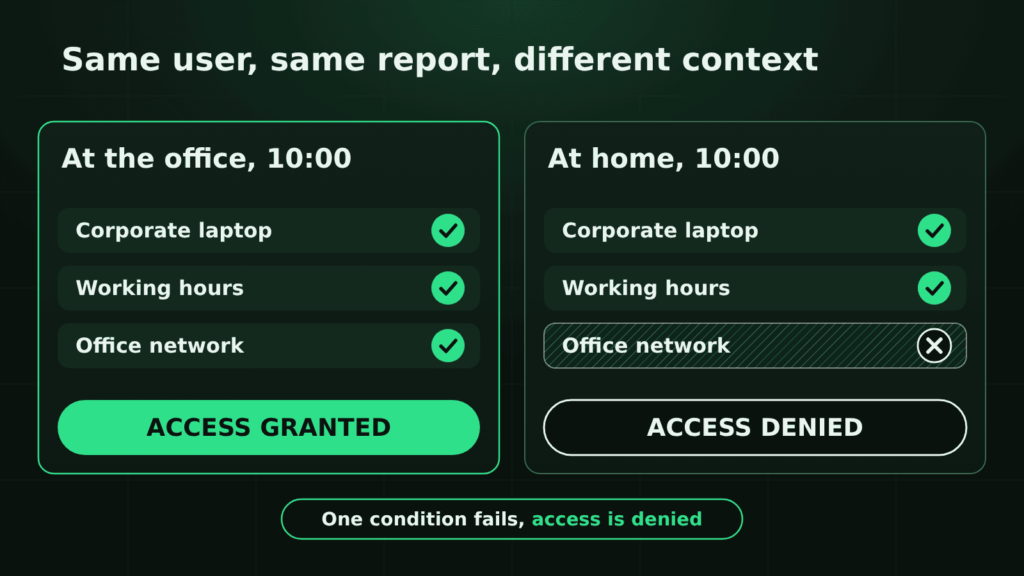
This high level of detail is ideal for global cloud infrastructure. It guarantees continuous and strict policy enforcement. The algorithm does not allow the system to rely on a job title alone. Permissions are managed almost automatically based on previously set conditions. Thanks to this, cloud entitlements remain up to date. The company easily supports continuous access rightsizing for each separate department without involving extra personnel.
Managing service accounts and Machine Identities
Corporate systems interact with each other more frequently than employees do. When considering role based vs attribute based access control, you must keep machine identities in mind. Various service accounts continuously exchange data. They also need the most reliable protection. Giving scripts and AI agents excessive permissions is a huge mistake. This very often leads to serious misconfigurations and security risks.
Security of machine and AI agents interactions requires a very careful approach and continuous identity monitoring. You can learn the technical details of these access control mechanisms through best practices for securing cloud service accounts, where the mechanisms of proper isolation of service identities are analyzed in detail.
And in order to always generate secure access policies for cloud storage without errors, it is advisable to use the S3 policy generator. This tool significantly reduces the risk of human error when writing complex policies.
Choosing the Right Approach for Identity Security
The direct answer to the question of role based access control vs attribute based access control is not clear cut. Organizations that successfully combine both models often achieve stronger identity security. Broad job roles are used for the basic configuration of personnel rights. Instead, dynamic attributes help protect the most sensitive information and very important cloud resources.
To build an effective and reliable architecture, you should follow a clear set of steps:
- Conduct a detailed risk assessment to fully understand the weak points of the corporate network.
- Use roles to standardize core processes so you don’t complicate settings where it’s completely unnecessary.
- Add attributes for reliable protection of confidential data through verification of geolocation or time of day.
- Set up continuous collection of audit logs for regular compliance checks.
- Limit any privileged access to strict time frames and regular confirmations from management.
It is simply impossible to manage such a complex hybrid configuration by hand. Full-fledged identity governance always requires a centralized security management platform. A high-quality CIEM tool centralizes access policies. It deeply analyzes available cloud permissions and automatically alerts administrators to policy violations. The integration of professional software instantly strengthens the overall cloud security posture of a business. The infrastructure becomes extremely resistant to any internal errors and external threats.