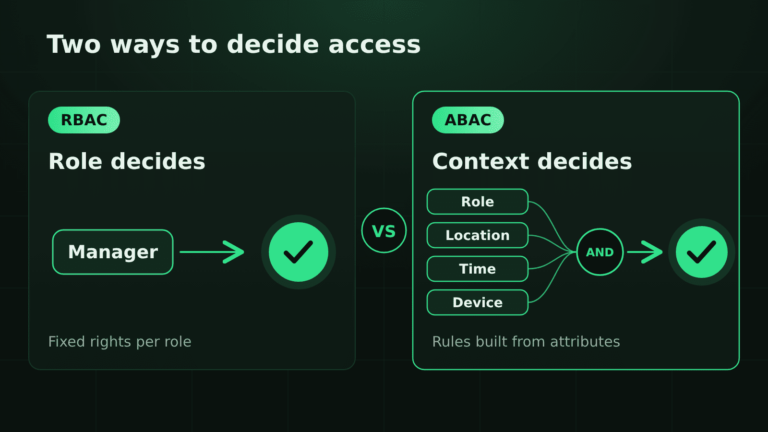
Good cybersecurity starts with knowing who can access what. IAM and IGA both deal with access to company resources, but they do different jobs. Giving people and services access is not enough.
Companies also need checks that keep that access under control. Below, we look at how IAM and IGA differ and why you need both to protect multi-cloud environments.
What Is IAM, and Why Isn’t It Enough?
A well-set-up IAM for cloud session helps employees reach company resources quickly and safely. For example, developers can safely access AWS, and managers can use internal tools with single sign-on (SSO) without logging in again and again. The main IAM tools are multi-factor authentication (MFA), SSO, and access policy management.

But IAM has a limit. It does not regularly check whether people still need the access they were given. For example, a junior developer may get temporary access to a production database. A few months later, IAM will not ask if they still need it. This is where IGA helps: it adds regular access reviews and governance controls.
What Is IGA? From Access Management to Identity Governance
While IAM manages identities and enforces access controls, IGA adds governance, oversight, and compliance processes. IGA helps organizations review access rights, track approvals, and enforce governance policies. Its main purpose is to regularly check whether assigned permissions remain appropriate and secure.
IGA helps organizations understand why specific cloud entitlements were granted, track approval chains, and verify compliance with access policies.
Key IGA capabilities include following processes:
- Identity lifecycle management covers employee onboarding, role changes, and offboarding, including the timely removal of access when employees leave.
- Regular access reviews allow managers to confirm whether team members still need their assigned cloud permissions.
- Segregation of duties (SoD) helps prevent conflicts of interest by ensuring that one person cannot both create and reconcile the same payment documents.
- Detailed audit logs help organizations demonstrate compliance and provide evidence during external audits.
IAM vs. IGA: Key Differences in Real-World Business Environments
To understand practical differences between IAM and IGA, let’s look at how they work in a growing business. As a company grows, its cloud infrastructure becomes more complex. Thousands of service accounts, API keys, and machine identities can accumulate and become difficult to track. These identities perform background operations and exchange data. Without proper oversight, they can accumulate excessive permissions, increasing security risks. Overprivileged accounts can become attractive targets for attackers.
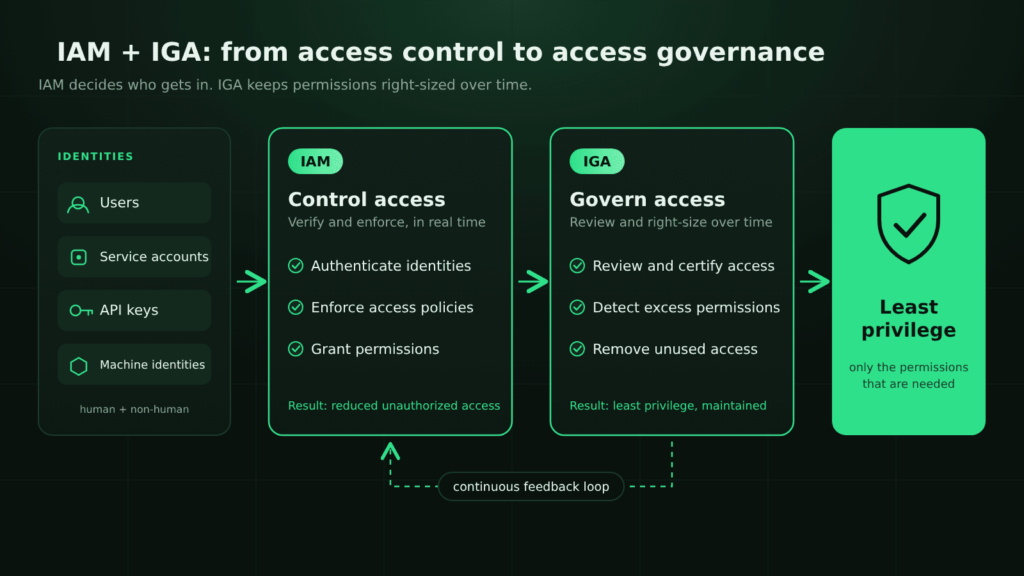
Established IAM practices help verify identities and enforce access policies, reducing risk of unauthorized access. IGA adds governance processes that help organizations maintain least-privilege access over time. The principle of least privilege means granting users and applications only the permissions they need to perform their tasks.
How IAM and IGA Work Together
Both approaches work together and help cover each other’s weaknesses. Integrating IAM and IGA helps organizations build a more comprehensive identity security strategy. IAM handles identity authentication and access enforcement, while IGA helps ensure that permissions align with business needs and company-wide policies.
IAM makes access decisions in real time, while IGA supports ongoing reviews as roles, responsibilities, and security requirements change. These reviews help keep access rights aligned with current responsibilities. Together, IAM and IGA support IT teams, employees, security professionals, and risk assessment specialists.
Why IAM and IGA Matter in Cloud Environments
Securing complex cloud environments requires a coordinated approach to identity and access management. For large infrastructures, effective cloud IAM risk management helps protect sensitive resources and maintain business continuity. Relying on IAM controls without appropriate governance processes can leave important security gaps. Relying solely on authentication is like installing a massive door and handing out keys to dozens of people without checking whether those keys are ever returned.
Without regular access reviews, outdated permissions and inactive accounts can accumulate across corporate cloud environments. For example, a developer might create temporary access permissions to test a new module and forget to remove them afterward.
Specialized tools can help reduce risk of human error. Instead of manually specifying every permission, tools such as an IAM policy generator can help create more targeted access policies and reduce manual configuration errors. This helps strengthen organization’s overall cloud security posture.
Building a Strong Identity Security Strategy
Building a secure infrastructure requires a consistent approach to managing identities and access permissions. A strong strategy includes several connected steps:
- Enforce strong access controls and multi-factor authentication (MFA), using biometric authentication where appropriate.
- Run regular automated access reviews to identify and remove unnecessary permissions.
- Monitor activity across both human and non-human identities, including employees, service accounts, and machine identities.
- Automate policy enforcement to maintain appropriate access levels while reducing manual administrative work.
Understanding what IAM and IGA each do is the first step toward building a stronger identity security strategy. Well-designed IAM helps users access resources efficiently, while IGA strengthens access governance, reduces security risks, and improves audit readiness.